 Scoreboard

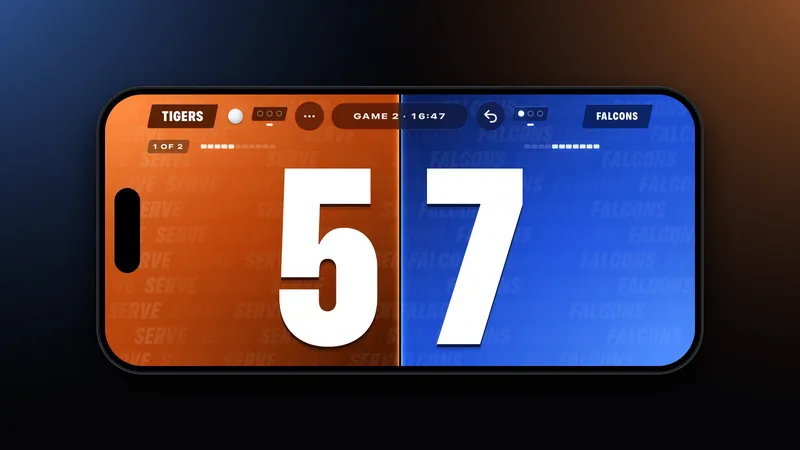
A table tennis game is won by the first player or pair to reach 11 points, unless the score reaches 10-10. From there you need a 2-point lead, so a game can finish 12-10, 15-13 or later. Every rally scores a point, whoever served (unless it's a let). The serve changes every 2 points, and from 10-10 it changes every point. A match is the best of an odd number of games, usually 5 or 7.
Those are the Laws of Table Tennis in the 2026 ITTF Statutes. Here's how each piece works, plus the 21-point game some people still play at home.
The short version
- Games to 11. At 10-10, play on until one side leads by 2.
- Every rally scores, on either side's serve.
- Serve changes every 2 points. From 10-10, each player serves 1 point in turn.
- Matches are best of an odd number of games, commonly best of 5 or best of 7.
- Change ends every game, and at 5 points in the last possible game.
- The 21-point game ended in 2001. It used five serves each.
Winning a game
Law 2.11 is short: a game is won by the player or pair first scoring 11 points, unless both reach 10, when the game goes to the first to gain a lead of 2. There's no cap. At 10-10 the game can go on as long as the players keep trading points.
Players call 10-10 deuce, and a 1-point lead after it is game point. Win it and the game's over. Lose it and you're back to level.
How the serve rotates
Law 2.13 sets the order:
- Choosing: the right to choose is decided by lot, such as a coin toss. The winner picks to serve, to receive, or which end to start at, and the other side gets the other choice.
- Every 2 points: after each 2 points, the receiver becomes the server. So the serve goes 2 to one side, 2 to the other, and so on.
- From 10-10: the order stays the same, but each player serves only 1 point in turn.
- Next game: whoever served first in a game receives first in the next one.
A quick check during a game: add the two scores. If the total is 0, 1, 4, 5, 8, 9 and so on, the first server of the game is serving. If it's 2, 3, 6, 7, the other side is. This works until 10-10.
Doubles
In doubles, the pair serving first chooses which of them serves, and in the first game the receiving pair chooses who receives first. At each change of serve, the previous receiver becomes the server, and the partner of the previous server becomes the receiver. In the last possible game, the pair due to receive next changes its receiving order when one pair first reaches 5.
Matches: best of 5 or 7
Law 2.12 just says a match is the best of any odd number of games, so competition organisers choose. Best of 5 (first to 3 games) and best of 7 (first to 4) are common in competition, and a friendly game can be best of 3 or a single game.
Changing ends
Players swap ends after every game. In the last possible game of a match, the deciding game 5 of a best of 5 for example, they also swap ends when one side first reaches 5 points.
The expedite system
To stop very long games, Law 2.15 brings in the expedite system after 10 minutes' play in a game, or whenever both sides ask for it. It isn't used if at least 18 points have been scored. Once it starts, players serve 1 point each in turn, and if the receiver makes 13 good returns in a rally, the receiver wins the point. It then stays on for the rest of the match.
The old 21-point game
Until 2001, table tennis games went to 21, and each player served five points in a row. The ITTF switched to games to 11 with serves every two points, starting on 1 September 2001, and matches grew from best of 3 or 5 to best of 7 or 9 games so they'd last about as long.
If your table still plays to 21, agree before the first serve on how often the serve changes and what happens at 20-20.
Common mistakes
- Stopping at 11-10. From 10-10 you need a 2-point lead.
- Serving two at a time after 10-10. It's one serve each from deuce on.
- Starting game 2 with the same server. Whoever served first in game 1 receives first in game 2.
- Forgetting to switch ends at 5 in the deciding game.
Keep table tennis score with Scoreboard Live
In Scoreboard Live, table tennis is the Ping pong board. It follows the serve for you, so nobody has to count.
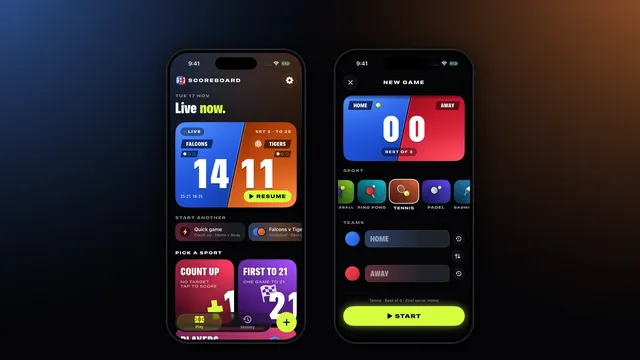
- Setup: BEST OF 1, 3, 5 or 7, and GAMES TO 11 or 21, always win by 2. The default is best of 5, games to 11. A TOSS chip picks the first server.
- The serve: it changes every 2 points (every 5 in games to 21), and every point from 10-10 (20-20). A court tag shows "1 OF 2" or "2 OF 2" for the serves in a turn.
- Ends: the two panels swap places between games and at 5 in the deciding game (10 in games to 21), with a SWITCH ENDS banner.
- On screen: DEUCE on the score bug at 10-10, GAME POINT, and MATCH POINT in a match of more than one game. Each side gets 1 timeout a match, with a 30-second countdown.
- Fix mistakes: tap a side for a point, pull down to take one back, and Undo goes back as far as the first point. A correction puts the serve back too.
Want the taps step by step? The how to score ping pong guide walks through the setup, the serve every 2 points and fixing a mistake.
For another racket sport with its own serving quirks, see tennis scoring explained, or badminton scoring rules for another game where every rally scores.
Scoreboard Live is free to download, and Ping pong comes with the one-time unlock. See the table tennis page, or get it on the App Store.
Keep score with Scoreboard Live
Scoreboard Live turns your iPhone into a big, bright scoreboard, with scoring on Apple Watch. Tap a side to score: it knows the rules of your sport, follows the serve and the sets, and puts the big moments on the board.