 Scoreboard


Tennis is scored in three layers: points make a game, games make a set, and sets make the match. Points in a game go love, 15, 30, 40, then game, but at 40-40 (deuce) you must win two points in a row. A set goes to the first player to six games with a two-game lead, with a tiebreak to 7 at six games all. Most matches are best of three sets.
The short version
- Points: love (0), 15, 30, 40, game. The server's score is called first.
- Deuce is 40-40. Win the next point for advantage, then one more for the game.
- No-ad scoring plays a single deciding point at deuce.
- Sets: first to six games, two clear. At 6-6, a tiebreak.
- Tiebreak: first to 7 points, two clear. A match tiebreak goes to 10.
- Match: best of three sets, or best of five.
Points: love, 15, 30, 40
The ITF Rules of Tennis list a standard game like this, with the server's score always called first:
- No points: love
- First point: 15
- Second point: 30
- Third point: 40
- Fourth point: game
So "30-15" means the server has won two points and the receiver one. "Love-40" means the server hasn't won a point yet and the receiver needs one more for the game, which would be a break of serve.
Deuce and advantage
If both sides win three points, the score is not "40-40" in umpire language but deuce. The next point gives that side the advantage. Win the point after that and you win the game; lose it and it's back to deuce. In short, after deuce you need two points in a row. A deuce game can go back and forth for a long time.
You'll often hear "ad in" when the server has the advantage and "ad out" when the receiver has it.
No-ad scoring
No-ad is an approved alternative in Appendix VI of the rules. The game is scored the same way up to deuce, then one deciding point is played and whoever wins it wins the game. The receiver chooses whether to receive that point on the right or the left side of the court. In mixed doubles, the player of the same gender as the server receives it.
Whether a match uses no-ad is up to the event or league, so check the format before you start.
Games and sets
The rules describe two main kinds of set:
- Tie-break set: first to six games with a two-game lead. At six games all, a tiebreak decides the set, which ends 7-6.
- Advantage set: first to six games with a two-game lead, and it simply keeps going until someone is two clear, so 8-6 or 12-10 can happen.
The event has to say in advance which one it uses, and whether the final set is a tie-break set or an advantage set.
There's also an approved short set: first to four games, two clear, with a tiebreak at four games all (or at three all, if the organiser chooses).
The tiebreak
In a tiebreak, points are counted simply: zero, 1, 2, 3 and so on. The first to 7 points with a two-point lead wins the tiebreak and the set. If it reaches 6-6, it continues until someone is two ahead.
Who serves in a tiebreak
- The player whose turn it is serves the first point, from the right side.
- The opponent serves the next two points.
- After that, each side serves two points in a row, alternating, until the tiebreak ends. In doubles the order inside each team carries on from the set.
Players change ends after every six points in a tiebreak. The player who served first in the tiebreak receives in the first game of the next set.
The match tiebreak to 10
Appendix VI also allows a match tiebreak: at one set all (or two sets all in a best of five), a single tiebreak replaces the final set. It goes to 10 points with a two-point lead. A separate option is a final set tiebreak to 10, played at six games all in the final set instead of the usual tiebreak to 7.
Serving and changing ends
- One player serves a whole game, then the receiver serves the next one.
- Every game starts from the right side, and the server alternates sides after each point.
- Change ends after the first, third and every odd game of each set.
Quick answers
- What is a break? Winning a game when the other side is serving.
- Is 7-5 a finished set? Yes: seven games with a two-game lead.
- Can a set finish 7-6 without a tiebreak? No. A finished 7-6 set means the tiebreak was played. An advantage set only ends with a two-game lead.
- Does the server's score come first? Yes, always, so 15-40 means the server is behind.
Keep tennis score with Scoreboard Live
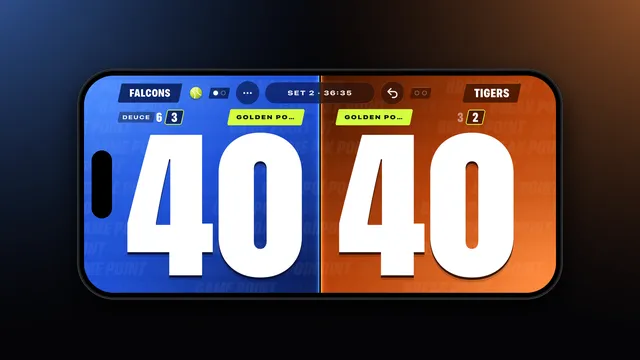
Scoreboard Live counts tennis the way an umpire calls it. Tap the player or team that won the point and the big numbers move through 0, 15, 30, 40 and AD. DEUCE, ADVANTAGE and GAME POINT, BREAK POINT, SET POINT and MATCH POINT show up on screen, and the score bug carries the set and the call, like "30-15", AD IN or AD OUT. It tracks who serves each game, the 1-2-2 serving order in a tiebreak and when to change ends.
Setup options for tennis:
- Best of: 1, 3 or 5 sets.
- At deuce: Advantage or Golden point (a single deciding point).
- Sets to: 6 games (tiebreak at 6-6) or 4 games (tiebreak at 4-4).
- Deciding set: Tiebreak, Tiebreak to 10, Play on (an advantage set), or Match tiebreak to 10.
Set tiebreaks go to 7, win by 2. Padel uses the same controls, with Golden point as its default. When the match ends you get the line score with any tiebreak points, saved to your history, and you can score from your Apple Watch.
Tennis comes with the one-time unlock. See tennis in Scoreboard Live, read what's in 1.0, or get it on the App Store.
Keep score with Scoreboard Live
Scoreboard Live turns your iPhone into a big, bright scoreboard, with scoring on Apple Watch. Tap a side to score: it knows the rules of your sport, follows the serve and the sets, and puts the big moments on the board.