 Scoreboard

In 501, each player starts on 501 and subtracts the score of every three-dart visit. The first to reach exactly zero wins the leg, and the last dart has to land in a double (the outer ring) or the bullseye. If a visit would take you below zero, leave you on 1, or reach zero without a double, it's a bust: the visit doesn't count and your score goes back to what it was. The highest possible finish is 170: treble 20, treble 20, bull.
That's the game as the World Darts Federation rules describe it. Here are the details, the variations you'll meet in a bar, and the finishes worth learning.
The short version
- Start on 501 (or 301 or 701) and count down. Each visit is up to three darts.
- Straight start: any dart scores from the first throw.
- Double out: the final dart must hit a double that brings you to exactly zero. The bull counts as double 25.
- Bust: over the score left, leaving 1, or zero without a double. The whole visit is cancelled.
- Highest checkout: 170. Seven scores below it can't be finished in three darts.
- Legs and sets: matches are best of an odd number of legs, or of sets made of legs.
301, 501 and 701
These are all the same game, called x01, with a different starting score. The World Darts Federation (WDF) rules say legs are played from a fixed odd number such as 501, 701 or 1001, and every score is subtracted from what's left.
- 501 is the usual game, and the first example the WDF rules give. Winmau's rules play it straight in.
- 301 is shorter, good for a quick bar game. Winmau's house rules note that 301 is often played double in, meaning darts only start scoring once you hit a double.
- 701 and higher starts are used for longer games and for teams.
Double out vs straight out
Under WDF rules every leg is a straight start and a double finish. To win you must land a dart in the double of half your remaining score. On 32, that's double 16. On 40, double 20. The inner bull is worth 50 and counts as double 25, so it finishes 50.
Casual games often use straight out (also called single out) instead, where any dart that reaches exactly zero wins. It's much easier, and fine for beginners, but agree on it before the first throw.
What counts as a bust
The WDF bust rule says a visit doesn't count, and your score stays as it was before that visit, if you:
- Score more than you have left. On 16, a single 20 is a bust.
- Leave exactly 1. You can't finish 1 with a double, so it's a bust straight away.
- Reach zero without a double. On 20, a single 20 is a bust under double out.
Example: you're on 36, and your first dart hits single 18, leaving 18. The second hits single 18 again: that reaches zero without a double, so it's a bust, and you're back on 36 for your next visit.
Checkouts: the finishes to learn
A checkout is the set of darts that takes you to exactly zero. The biggest one is 170 (T20, T20, Bull). DartCounter lists 169, 168, 166, 165, 163, 162 and 159 as bogey numbers: under 170 but impossible to finish in three darts. On those, your job is to set up a finish for the next visit.
A few routes worth knowing by heart:
- 170: T20, T20, Bull
- 160: T20, T20, D20
- 140: T20, T20, D10
- 121: T20, T11, D14
- 100: T20, D20
- 80: T20, D10
- 64: T16, D8
- 40: D20 (the classic "tops")
- 32: D16
32 and 40 are forgiving leaves, because a single still leaves a double. Hit single 16 on 32 and you're on 16, which is double 8. Hit single 20 on 40 and you're on 20, double 10.
Legs, sets and who throws first
A leg is one game from 501 down to zero. The WDF rules say a match divided into legs is played as best of an odd number (3, 5, 7 and so on), and a set is a group of legs, also best of an odd number. Win the majority and the remaining legs or sets aren't played.
At WDF events, a throw at the bull decides the order: the player closest to the centre throws first in the first leg and in every odd-numbered leg, so the start alternates from leg to leg.
The three-dart average
The three-dart average is the average score per visit of three darts. Work it out as the total points scored divided by the darts thrown, times three. A 501 leg finished in 15 darts is 501 / 15 x 3 = 100.2. It's the single best number for comparing players, and 180 (three treble 20s) is the maximum for one visit.
Common mistakes
- Forgetting a bust cancels the whole visit, not just the last dart.
- Leaving 1. On 3, don't aim for single 2. Aim single 1, then double 1.
- Going for a bogey number. On 159 or 169, play a set-up visit instead of chasing a finish that isn't there.
- Subtraction slips. Call out the score left after every visit, so both players can check it.
Keep darts score with Scoreboard Live
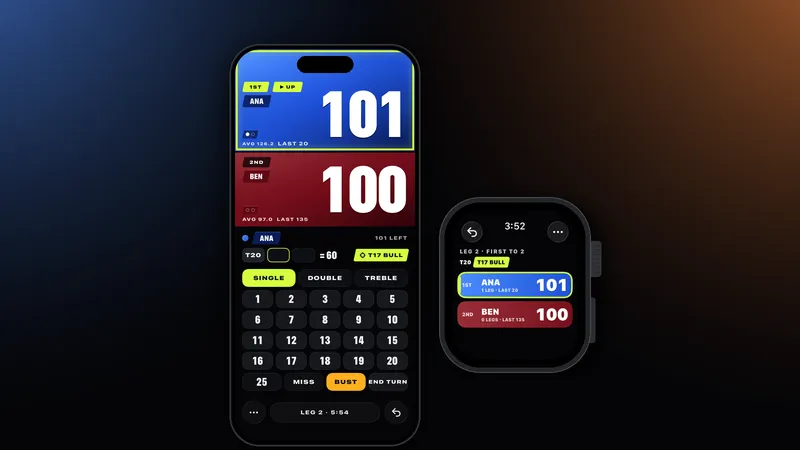
Scoreboard Live has a darts board for 2 to 8 players that does the subtraction, the bust rule and the checkout maths for you.
- Setup: GAME 301, 501 or 701. FINISH Double out or Straight out. ENTRY Dart by dart or Turn total. LEGS best of 1, 3, 5 or 7, and SETS Off, 3 or 5. The first throw moves round leg by leg.
- Dart by dart: a dart pad with SINGLE, DOUBLE, TREBLE, BULL, MISS, BUST and END TURN. Or type the visit total: the pad refuses totals three darts can't score.
- Busts handled: going below zero, leaving 1 under double out, or reaching zero without a double puts the score back to the start of the turn. The bull counts as a double.
- Checkout to aim at: the board shows a checkout for the score left.
- Stats: the three-dart average (AVG), 180s, the highest checkout (BEST OUT) and the best leg, with full-screen moments for 180, BUST and CHECKOUT.
Darts is scored on the iPhone. On Apple Watch the game is view-only: you see who's throwing, the score left and the checkout. For more bar games, see the cornhole scoring rules.
Scoreboard Live is free to download, and darts comes with the one-time unlock. See the darts page, or get it on the App Store.
Keep score with Scoreboard Live
Scoreboard Live turns your iPhone into a big, bright scoreboard, with scoring on Apple Watch. Tap a side to score: it knows the rules of your sport, follows the serve and the sets, and puts the big moments on the board.