 Scoreboard

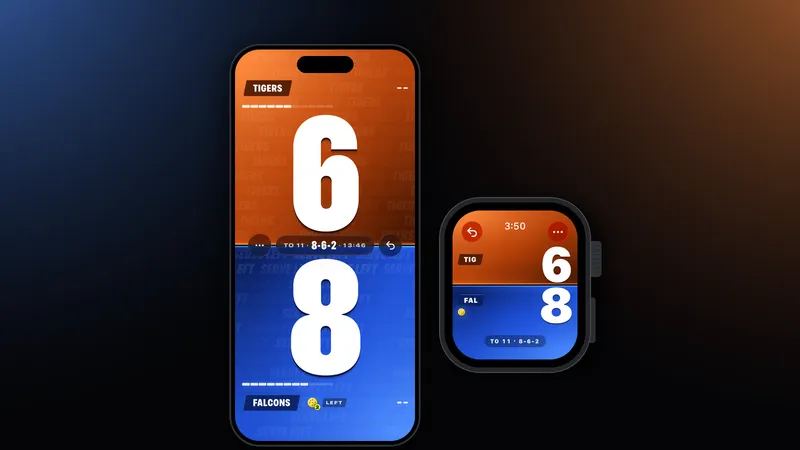
In standard pickleball, only the serving side can score: you win a point by serving and winning the rally. If the serving side loses the rally, nobody scores and the serve moves on. In doubles both partners serve before the serve passes to the other team, except at the very start of the game, which is why the first call is 0-0-2. Games are usually to 11, and you must win by 2.
The short version
- Side out scoring (the standard): points only on your own serve.
- Rally scoring (an option some events use): a point on every rally, whoever served.
- Doubles call: serving team's score, receiving team's score, server number. Example: 8-6-2.
- The game starts at 0-0-2, so the first team gets only one server.
- Games to 11, 15 or 21, win by 2. Best 2 of 3 to 11 is the most common tournament match.
Side out scoring: points only on serve
The 2026 USA Pickleball rulebook puts it in one line: a point is scored by serving the ball and winning the rally. When the receivers win a rally, they don't get a point. They win the right to serve, or they move the serve one step closer to them.
In singles that step is simple. You keep serving, switching sides after each point, until you lose a rally. Then it's a side out and your opponent serves.
In doubles each team gets two servers per turn:
- Server 1 serves until the team loses a rally. The serve then passes to the partner.
- Server 2 serves until the team loses another rally. That's a side out, and the other team takes over with its own server 1.
Who is server 1? After each side out, the player standing on the right side for the team's score starts. That player is server 1 for the whole turn, and the partner is server 2.
Why the game starts at 0-0-2
Serving first is an advantage when only the server can score. To even it out, the starting server of the first team counts as the second server for that first turn. One lost rally and it's a side out. The rulebook says the score is called "zero, zero, two" to start each doubles game, and in singles "zero, zero".
Calling the score
The server normally calls the score before every serve, and the whole call has to be finished before the serve is hit.
- Doubles: three numbers. The serving team's score, then the receiving team's score, then the server number. So 8-6-2 means the serving team has 8, the receivers have 6, and this is the second server.
- Singles: two numbers, the server's score first.
- Rally scoring: two numbers in doubles too, the server's score first.
The serving team's score always comes first, even when it's behind. A call of 3-7-1 is normal. If you're unsure, ask before the serve: the rules say a player may ask the opponent for the correct score, and the opponent has to answer.
Which side to serve from
Your score tells you. In singles, serve from the right when your score is zero or even and from the left when it's odd. In doubles, the team's starting server is on the right when the team score is even and on the left when it's odd, with the partner on the other side. If the positions look wrong, check the score first.
Rally scoring: a point every rally
USA Pickleball lists rally scoring as a provisional option, not the standard. With it, the side that wins each rally scores, serving or not. In doubles there's only one server per turn, so a lost rally on serve is a side out straight away, and the call drops to two numbers.
Tournament directors can choose rally scoring for many events, but the 2026 rulebook excludes double-elimination doubles events, Golden Ticket events and the National Championship. Leagues and clubs set their own format, so check before you play. Rally games are still to 11, 15 or 21, win by 2.
Winning the game
Games are typically to 11, and you need a lead of at least 2 points. If it's 10-10, play goes on until someone is 2 ahead, so 12-10 or 15-13 can happen.
Tournament formats in the rulebook, all win by 2 (team play may use win by 1):
- Best 2 of 3 games to 11.
- Best 3 of 5 games to 11.
- One game to 15 or to 21.
- One game to 11, for round robin events with six or more teams.
Switching ends and timeouts
Players change ends between games. In a one-game match or the deciding game, they also change ends when the first side reaches 6 in a game to 11, 8 in a game to 15, or 11 in a game to 21.
Each side gets two time-outs per game to 11 or 15, and three in a game to 21. Each one lasts up to a minute.
Common mistakes
- Giving the receivers a point. In side out scoring, winning a rally on the other team's serve only takes the serve back.
- Starting at 0-0-1. The first doubles turn has one server, so it's 0-0-2.
- Calling your opponent's score first. The server's side always comes first.
- Stopping at 11-10. Win by 2.
- Forgetting the end change at 6 (or 8, or 11) in the deciding game.
Keep pickleball score with Scoreboard Live
Scoreboard Live keeps the whole call for you. Tap the side that won the rally and it works out the point or the side out, the server number and which side serves. The call shows on the board the way you'd say it, like 8-6-2, with SIDE OUT and 2ND SERVER plates and a RIGHT or LEFT tag for the serve. Doubles side out games start at 0-0-2.
On the setup page you choose:
- Scoring: Side out or Rally.
- Players: Doubles or Singles.
- Game to: 11, 15 or 21, always win by 2.
- Best of: 1, 3 or 5.
- Switch ends: on or off. The sides swap between games and at the middle of the deciding game.
Timeouts follow the game length, two per game to 11 or 15 and three to 21, with a 30-second countdown on screen. Pull down on a side to undo a wrong tap, or score from your Apple Watch.
Pickleball comes with the one-time unlock, along with every other sport. See pickleball in Scoreboard Live, read what's in 1.0, or get it on the App Store.
Keep score with Scoreboard Live
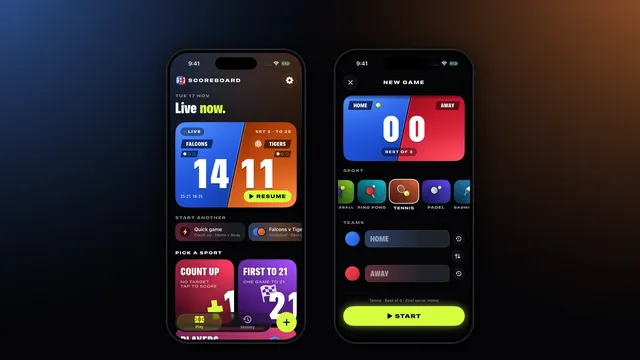
Scoreboard Live turns your iPhone into a big, bright scoreboard, with scoring on Apple Watch. Tap a side to score: it knows the rules of your sport, follows the serve and the sets, and puts the big moments on the board.