 Scoreboard

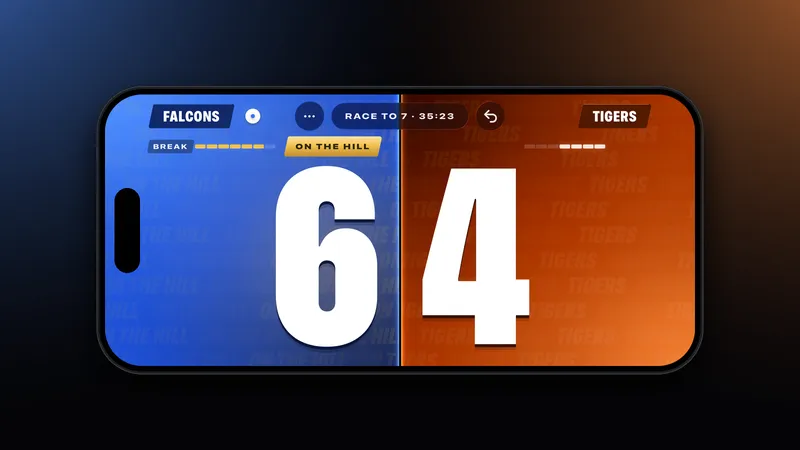
In pool, a "race to 7" means the first player to win 7 racks (games) wins the match. Each rack is worth one, whoever breaks and however long it takes, so a race to 7 can end 7-0 or 7-6. The race length is set by the league or the event, and it often changes with the game: 8-ball, 9-ball and 10-ball races are not always the same length.
The short version
- A race to N is won by the first player to win N racks.
- One rack, one point. In 8-ball you win a rack by legally pocketing the 8-ball; in 9-ball, the 9-ball; in 10-ball, the 10-ball.
- The lag decides who breaks first. After that, the break follows a rule: alternate, winner breaks or loser breaks.
- Under the WPA rules, rack-scored games like 9-ball use alternate breaks, but events can set their own break rule.
- On the hill means one win away. Hill-hill means both players need one rack.
What a race is
Most pool you play in a bar, a league or a tournament is scored by the rack. You don't count balls or points across the match. You count racks won, and the match ends the moment one player reaches the target. That target is the race: race to 3, race to 5, race to 7, race to 9 and so on.
Because there's no "win by two", the last rack can be decisive at any score. If it's 6-6 in a race to 7, the next rack wins it.
Bigger events sometimes split the match into sets. The WPA defines a set as part of a match, with a number of sets needed to win the match and a number of racks needed to win each set. Most casual and league play skips sets and just plays one race.
What wins a rack in 8-ball, 9-ball and 10-ball
The race counts racks, so it helps to know exactly when a rack is over. From the WPA Rules of Play:
- 8-ball: each player has a group of seven balls (1 to 7 or 9 to 15) and must clear it before pocketing the 8-ball to win. You lose the rack if you pocket the 8-ball and foul, pocket it before your group is cleared, pocket it in an uncalled pocket, or drive it off the table. Pocketing the 8-ball on a legal break isn't a foul: the breaker can spot it and play on, or break again.
- 9-ball: balls are played in ascending order, and the player who legally pockets the 9-ball wins the rack.
- 10-ball: a call shot game, also in ascending order. The rack goes to the player who legally pockets the 10-ball when it's the only object ball left.
How long is the race?
There's no single official length. The WPA's Playing Regulations say some things vary from tournament to tournament, such as the number of sets in a match, and leave them to the event. So the race is whatever your league, room or tournament director says it is.
A few patterns you'll meet:
- Even races: both players race to the same number.
- Handicapped races: in APA 8-ball, your skill level sets how many games you need. The APA's own example has a skill level 6 racing to 5 while a skill level 4 races to 3.
- Point races: APA 9-ball isn't a rack race at all. Each ball pocketed is worth 1 point and the 9-ball is worth 2, and your skill level sets the points you need.
If you're setting up your own match, agree the race before the lag. Shorter races suit a busy table; longer ones give the better player more room to come through.
Who breaks: alternate, winner or loser
The lag
Under WPA rules the lag is the first shot of the match. Each player shoots a ball from the head end of the table to the foot cushion and back, at about the same time. The ball that stops closer to the head cushion wins, and the winner chooses who breaks the first rack.
After the first rack
- Alternate break: players take turns breaking, whatever happened in the last rack. WPA rule 1.3 says that in disciplines scored by the rack, like 9-ball, the break alternates.
- Winner breaks: whoever won the last rack breaks the next one, so a strong breaker can string racks together.
- Loser breaks: whoever lost the last rack breaks. It gives the trailing player the next chance at the table.
The WPA regulations mention who breaks after the first rack at 9-ball as one of the things tournaments decide for themselves, so check the house rule before you start.
On the hill and hill-hill
"On the hill" means a player needs one more rack to win the match. In a race to 7, a player with 6 is on the hill. When both players are one rack away, it's hill-hill: in a race to 7 that's 6-6, and the next rack takes the match.
Keeping a race score
Pool scoring is simple, which is exactly why it goes wrong. Nobody writes it down, a rack gets argued about, and suddenly it's "was that 5-4 or 4-4?" A few habits help:
- Mark the rack when it ends, not after the next break.
- Track the break along with the score, especially in alternate break, where a re-rack or a stalemate can confuse who's up next. Under WPA rules, a stalemate in 8-ball or 9-ball is re-broken by the original breaker.
- Say the race out loud at the start: "race to 7, alternate breaks".
Common mistakes
- Counting a scratch on the 8-ball as a re-rack. Outside the break, pocketing the 8-ball and fouling loses the rack.
- Switching break rules mid-match. Pick alternate, winner or loser break before the lag and keep it.
- Playing to "win by two". A race has no margin rule. 7-6 wins a race to 7, unlike table tennis, where a game needs a 2-point lead from 10-10.
- Assuming tournament rules at the bar. House rules vary, so ask first.
Keep score with Scoreboard Live
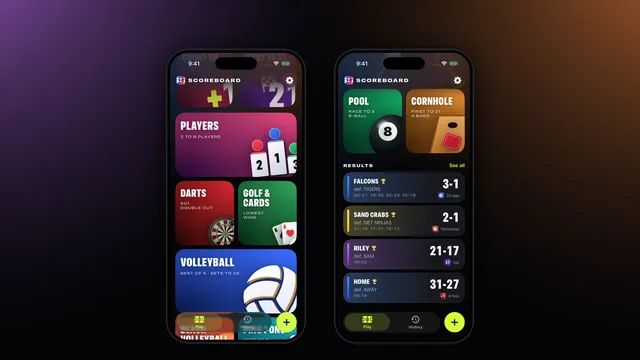
Scoreboard Live has a pool board for races. Tap a side when they win a rack, pull down on a side to take one back, and undo goes all the way back to the first rack. The score bug shows the race, like "RACE TO 7", a BREAK tag sits on the player who breaks next, and ON THE HILL and HILL-HILL come up on screen when the match gets close.
Setup options for pool:
- Game: 8-ball, 9-ball, 10-ball or Other. Picking a game sets a usual race (5 for 8-ball, 7 for 9-ball and 10-ball), which you can change.
- Race to: any number of racks from 1 to 99.
- Break: Alternate, Winner or Loser.
- First break: pick a player, or use the TOSS chip for a coin toss if you'd rather not lag.
When the race ends, the result is saved to your history with a matchday poster you can share, and you can score the match from your Apple Watch.
Want the taps step by step? The how to score pool guide walks through the race, the break rule and the hill.
Pool comes with the one-time unlock. See pool in Scoreboard Live, read darts 501 rules and checkouts for the other bar game, or get it on the App Store.
Keep score with Scoreboard Live
Scoreboard Live turns your iPhone into a big, bright scoreboard, with scoring on Apple Watch. Tap a side to score: it knows the rules of your sport, follows the serve and the sets, and puts the big moments on the board.